
|
Getting your Trinity Audio player ready...
|
Property management forms are the foundation of a well-managed and legally compliant rental business. From rental applications and lease agreements to late rent notices and move-out forms, property management forms ensure good communication, documentation, and legal compliance.
Landlords who use proper documentation build strong landlord-tenant relationships, stay organized, prevent disputes, and have the documentation they need if issues arise. The result is a better experience for landlords and tenants and improved rental outcomes.
You can minimize headaches and maximize rental returns with good landlord documentation. Below is an overview of some essential forms and how they can lead to better rental outcomes.
Ready to customize the Landlord documents you need? Create a free ezLandlordForms account to access our library of over 500 property management forms.
Common Types of Property Management Forms
There are many different documents that property owners use, but some of the most common types of landlord forms are:
- Screening documents
- Leasing documents
- Security deposit forms
- Operations and maintenance forms
- Lease violation and eviction documents
- Move-out and property turnover forms
The reality is, landlords need documentation for every phase of the rental process.
What Forms Do Landlords Need to Manage Rentals?
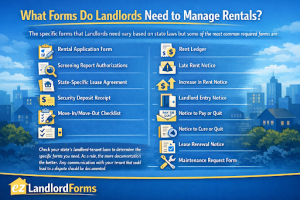
The specific forms that landlords need vary based on state laws, but some of the most common required forms are:
- Rental application form
- Screening report authorizations
- State-specific lease agreement
- Security deposit receipt
- Move-in/move-out walkthrough checklist
- Rent receipt
- Rent ledger
- Late rent notice
- Increase in rent notice
- Landlord entry notice
- Notice to pay or quit
- Notice to cure or quit
- Lease renewal notice
- Maintenance request form
The best way to determine the specific forms you need is to check your state’s landlord-tenant laws. That said, as a general rule, the more landlord documentation, the better. Any communication with your tenant that could lead to a dispute should be documented.
What Property Management Forms Protect Landlords the Most?
When it comes to rental property forms, the lease agreement is by far the most important document for landlords and tenants. The lease, or rental agreement, outlines all rules and terms of the rental relationship. It helps avoid confusion and prevent disputes. If issues arise, the lease is what protects a landlord. A detailed, state-specific lease sets both parties up for success.
Besides the lease, some other forms that protect landlords include:
- Security deposit forms. The security deposit is a common source of conflict. Landlords who have a security deposit receipt, move-in/move-out checklist, and documentation of itemized deductions are protected if disputes arise.
- Rent payment documentation. If a tenant falls behind on rent, landlords need documentation of all payments. This can come from a detailed rent ledger or documentation in a rent payment portal.
- Eviction forms. If a tenant violates the rental agreement or falls behind on rent, landlords must follow all procedural requirements to legally evict the tenant. This includes providing adequate notice and providing documentation of that notice. Failure to comply with all procedural requirements can delay the eviction process.
- Screening documentation. To avoid claims of discrimination or violations of fair housing laws, landlords should keep good documentation of all applicant screenings. This includes a copy of the written screening criteria, the rental application, and authorizations to run necessary reports.
Frequently Asked Questions About Property Management Forms
How do landlord and tenant forms reduce legal risk?
Property management forms drastically reduce legal risks by providing landlord documentation of all communication and payments. Plus, some forms serve as enforceable contracts and legal documentation of agreements between landlords and tenants.
Landlord forms ensure legal compliance with applicable lease laws and professional, consistent property management systems. They help prevent disputes, ensure that landlords are organized, and protect landlords when disputes arise.
Are digital rental property forms legally valid?
Yes, digital landlord forms are legally valid. Electronic forms are treated the same way as physical documents as long as: there is a clear signature by both parties, the documents are stored and accessible, and the electronic copies are accurate and complete.
That said, in some states, landlords must deliver hard copies of eviction notices to their tenants.
Can Landlords manage properties without forms?
In most states, landlords can technically manage their rentals without forms. However, in practice, it’s never a good idea to do so. Without forms, landlords are at a high risk of disputes, legal compliance issues, and general disorganization.
To ensure your rental business runs smoothly, efficiently, and legally, it’s always a good idea to use property management paperwork throughout the rental process.
Get the Property Management Forms You Need in One Place
The good news is that landlords can get the property management paperwork they need all in one place. At ezLandlordForms, you get access to over 500 landlord forms, including state-specific leases and notices.
Landlords can customize firms, save templates, and securely store all documentation. Create a free account today to start customizing the landlord notices you need.
Emily Koelsch, ezLandlordForms Contributing Writer
 Emily Koelsch is a freelance writer and blogger, who primarily writes about business, real estate, and technology.
