

|
Getting your Trinity Audio player ready...
|
Required Lease Disclosures Landlords Often Forget (Including Lead Paint)
Landlords have to comply with federal, state, and local laws when drafting a lease agreement. This means including all state-required terms and disclosures in the lease package. Landlords who opt for a generic lease or basic lease template often omit key disclosures required by their state’s landlord-tenant laws.
In this guide, we’ll cover commonly overlooked lease disclosures, the consequences of omitting required disclosures, and best practices for creating a legally compliant lease agreement.
Ready to start customizing your state-specific lease? Visit ezLandlordForms to customize a complete lease package in just a few clicks.
Which Required Lease Disclosures Do Landlords Most Often Miss?
Required lease disclosures vary by location, property type, and property age. That said, there are some commonly overlooked lease disclosures.
The most commonly missed disclosure is the lead-based paint disclosure and pamphlet. Under federal law, this is required for all rental units built before 1978. It’s the disclosure that applies to most landlords and is frequently omitted from basic leases.
In addition, some other commonly omitted disclosures are: flood zone disclosures, known mold or water intrusion disclosures, owner or authorized agent identification, security deposit requirements, and bed bug history.
The single most common mistake for landlords is using a generic lease that is not customized for the state where the rental property is located. This often results in missing terms, clauses, and disclosures, leaving landlords unprotected.
The Federal Lead-Based Paint Disclosure: Required Lease Disclosure for Properties Built Before 1978
One required lease disclosure that applies to all states is the lead-based paint disclosure. Under this federal law, landlords must:
- Disclose any known lead paint hazards
- Provide tenants with any available lead paint reports or records
- Give tenants the EPA lead paint pamphlet, Protect Your Family From Lead in Your House.
- Include the lead warning statement in the disclosure
- Signatures of landlords and tenants documenting that all information was provided to the tenant
Landlords should include the lead-based paint disclosures and EPA lead paint pamphlets at lease signing and renewals. Both parties should sign the disclosure, and landlords need to keep executed copies for at least 3 years.
While this is a required disclosure for all states, there are some properties that are exempt from the requirement. Landlords do not have to provide lead-based paint disclosures for:
- Properties built in 1978 or later
- Some short-term rentals of 100 days or less
- Housing inspected by a certified professional and found to be free of lead-based paint
- Studios or “zero-bedroom units,” unless a child under 6 lives in the unit
- Housing designated for the elderly or disabled, unless a child under 6 lives in the unit
Common State and Local Lease Disclosure Requirements
In addition to the lead paint requirement, each state has its own lease disclosure requirements. This is what can make lease creation tricky – and what makes using a generic lease so risky. Landlords need to review state and local lease requirements to ensure they have a legally compliant lease that will protect them and hold up in court.
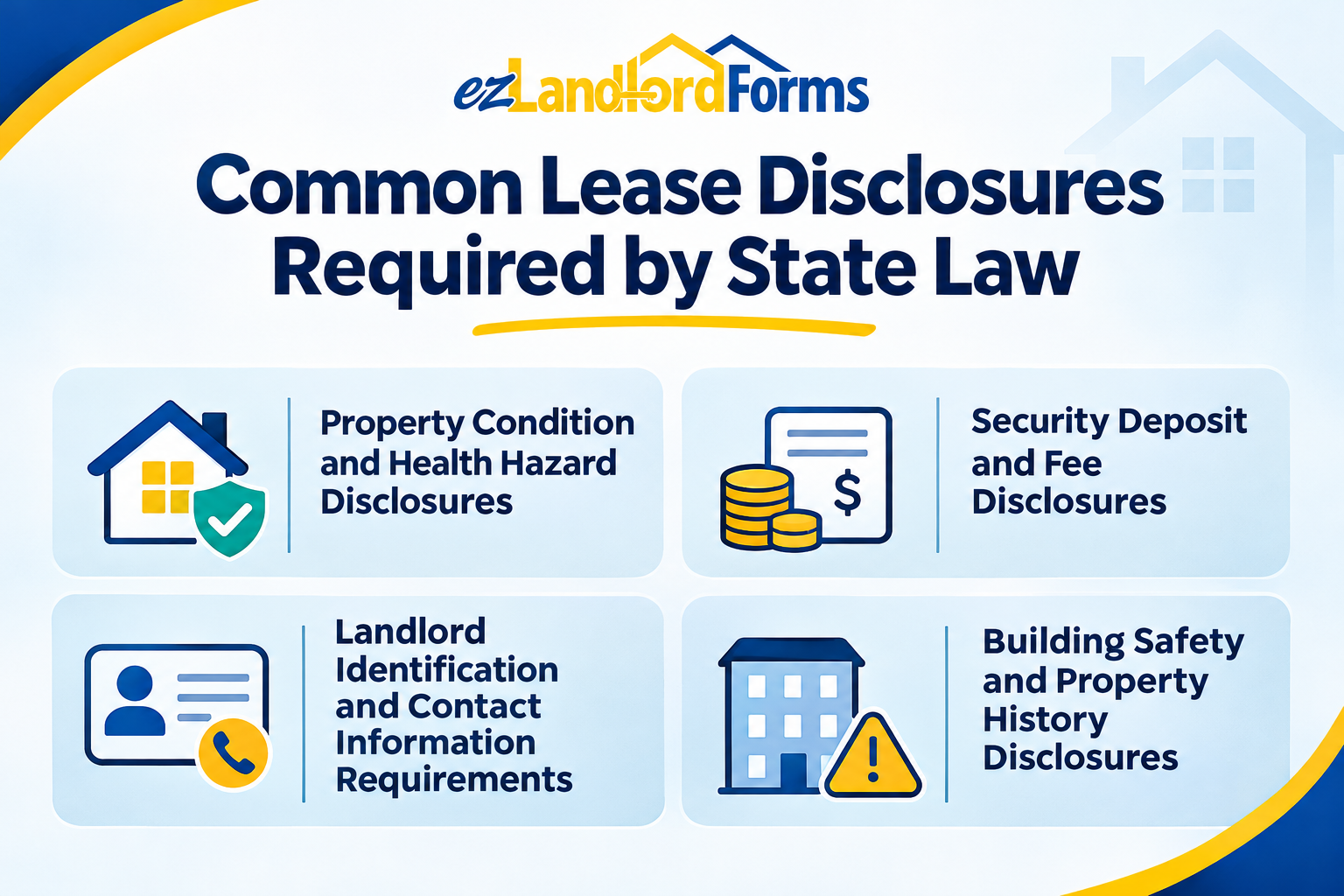
While the exact landlord disclosure requirements vary, there are some common lease disclosures that are frequently required by state law. The major categories of required lease disclosures are:
- Health, Safety, and Property Condition Disclosures
- Security Deposit and Fee Disclosures
- Landlord Identification and Contact Information Requirements
- Building Safety, Property History, and Policy Disclosures
Health, Safety, and Property Condition Disclosures
Property condition and health hazard lease disclosures are focused on landlords disclosing potential hazards or property history that could impact a tenant’s safety or decision to rent the unit. The general principle around these disclosures is that if there is a hazard known to the landlord but not visible to the tenant, landlords need to disclose what they know.
This category of disclosures includes environmental hazards, dangerous conditions, or potential health issues. Some common required disclosures include:
- Mold disclosures or safety statements
- Water intrusion or presence in a flood zone
- Pest or bed bug disclosure
- A history of methamphetamine or drug manufacturing
Security Deposit and Fee Disclosures
Many states require landlords to provide specific disclosures about the security deposit, nonrefundable fees, and mandatory fees. The objective here is to ensure there is transparency about all deposits and mandatory tenant fees.
Some of the most common requirements are:
- Non-refundable fee disclosures
- Statements about how security deposits are held and returned
- Late fee policies and amounts
- Disclosures of any mandatory monthly fees in addition to rent
- Shared utilities explanations and disclosures
Landlord Identification and Contact Information Requirements
Most states require landlords to disclose the name and contact information for the landlord and any authorized agents acting on the landlord’s behalf. This is important for transparency, to ensure tenants have a name and address for official notices, and to ensure tenants know who is responsible for the rental property.
Some common disclosures required in this category are: emergency contact information, authorized agent identification, and contact information for official notices.
Building Safety, Property History, and Policy Disclosures
Building safety disclosures involve things like smoke and carbon monoxide detector information, smoking policies, and any pending disclosures or planned demolitions. This is information that helps tenants make a decision about a rental unit and ensures they stay safe in the rental.
Some of the most common state-required disclosures are:
- Smoke detector disclosures
- Smoking policy disclosures
- Notice of intent to demolish
- Recycling ordinance notices
- Death on the premises disclosures
- Window guard disclosures
What Happens If a Landlord Omits a Required Disclosure?
When a lease is missing required disclosures, it can result in portions of the lease being unenforceable, statutory penalties, civil liability, tenant defenses in eviction proceedings, and the loss of landlord rights.
The penalty varies depending on the disclosure missing and the specific facts of the situation. For example, federal law states that landlords who don’t comply with lead-based paint disclosures may be liable for up to three times the tenant’s damages plus the potential for civil and criminal penalties.
It’s important to note that these consequences usually show up at the worst moment – for example, when landlords are in court or in the midst of an eviction case. If you determine that your lease is missing a required disclosure, you should:
- Promptly provide the tenant with the missing disclosure as a lease addendum
- Document that the tenant received the disclosure
- When applicable, address any environmental hazards or unsafe conditions identified
- When necessary, seek legal advice to mitigate damages and understand your rights
Frequently Asked Questions About Required Lease Disclosures
Which Lease Disclosures Are Required in Every State?
The lead-based paint disclosure for properties built before 1978 is the only federally-required disclosure that applies to every state. Other disclosures are required by state or local law, so they vary from one location to the next. Landlords should review lease disclosure requirements by state to ensure compliance.
Do Landlords Have to Test for Lead Paint?
No, landlords are not required to test for lead paint. The lead paint disclosure requirements require landlords to disclose known lead-based paint hazards and any available records or reports.
What Must a Landlord Disclose About the Presence of Lead Paint?
Landlords must disclose any known lead-based paint hazards on the property and any records or reports about lead paint in the rental. Landlords are not required to test or inspect the property for lead paint.
Do Disclosures Have to Be Given Again at Renewal?
State laws vary as to whether or not disclosures have to be given at renewal. However, a safe approach is to always provide tenants with a full lease package at renewal, including required disclosures. Landlords should also provide tenants with updated disclosures any time facts change – for example, a new property manager, evidence of environmental hazards, or new property rules.
What Happens if a Required Disclosure Is Left Out of the Lease?
If a required disclosure is missing from a lease package, it can result in portions of the lease being unenforceable, financial penalties, civil liability, or a tenant defense in an eviction or security deposit case. The landlord’s failure to disclose the penalty can be significant, so it’s important for landlords to review and comply with applicable requirements.
When Must Landlords Provide Required Lease Disclosures?
The timing for lease disclosures varies, but in most cases the tenant must receive lease disclosures before entering into the lease agreement. In many cases, the purpose is to provide tenants with information that could impact their decision to rent a property. Because of this, it’s generally required that tenants have an opportunity to review the disclosure before lease signing. That said, landlords should review local, state, and federal laws to confirm timing requirements for disclosures.
Can Cities Require Additional Lease Disclosures?
Yes, cities and counties may require disclosures beyond state and federal law. Some common examples of municipal requirements are recycling ordinances, smoking policies, bed bug disclosure requirements, tenant-rights notices, and rent-control disclosures.
How to Build a Legally Compliant Lease Package
To build a legally compliant lease package, landlords need to start with a state-specific lease agreement that includes all state-required terms, clauses, and disclosures. Each required disclosure should be attached as an addendum and signed by the parties. Landlords should keep signed disclosures for at least three years.
In addition, landlords should:
- Update disclosures any time facts or laws change
- Provide tenants with updated disclosures when renewing the lease
- Review local laws to ensure compliance with county or municipal disclosure requirements
ezLandlordForms makes it easy for landlords to create a state-specific lease package. Follow user-friendly prompts to customize a legally compliant lease package for your state. If you need help, our team is available by chat or phone to answer questions. Start building your lease for free now.
Emily Koelsch, ezLandlordForms Contributing Writer
 Emily Koelsch is a real estate investor and self-managing landlord who has owned and managed single-family and multi-family rentals since 2014. She has written for ezLandlordForms since 2020. Comment end
